Goals Are a Mind Game First
Most players can strike a ball well. Few can finish consistently. At the elite level, the difference isn’t technique, it’s mentality. Scoring goals is as much a mental game as a mechanical one. I’ve worked with players who’ve scored in World Cups, Olympics, and Champions League finals. It’s never just about technique. The physical act of shooting is only the final step; the build up, confidence, decision, conviction, happens in the six inches between your ears. In other words, the top strikers separate themselves with their minds. They approach each chance with an assassin’s calm and a relentless belief that the next shot is going in, no matter what came before.
Mindset of Elite Strikers
World class strikers all share a killer mindset. Key psychological traits set them apart: unshakeable confidence, ice cold composure under pressure, unbreakable self belief, and lightning anticipation. They are obsessed with scoring, borderline compulsive about putting the ball in the net. This mentality is cultivated, not born. For example, Alex Morgan’s goal obsession shows up in her training habits: after team practice ends, she’ll often grab a bag of balls and keep firing away on an empty field. Those extra reps aren’t about fitness or technique alone, they build her mental expectation to score. All those solo hours paid off in her clinical finishing and close control under pressure . Morgan has long been known for her dedication outside regular training, taking charge of her development because she expects more of herself . That hunger to do “one more rep” feeds an inner confidence; when a chance falls to her in a game, she’s been there a thousand times in her head and in training.
Elite forwards also cultivate supreme self belief and resilience. England’s Rachel Daly is a prime example. Daly’s path wasn’t straightforward, her versatility meant she often played out of her natural striker position for the team. Rather than complain, she embraced it, developing a mentally tough, team first attitude. She learned to thrive anywhere on the pitch, which in turn made her an even sharper striker when she moved up top. Her resilience shows in other ways too. In 2021, just days after losing her father, Daly still stepped onto the field and scored a stoppage time goal in his honor . Her coach applauded her “incredible” strength and composure during such an emotional time . That is the mindset of an elite scorer, life hits hard, pressure mounts, but when there’s a goal to be had, they meet the moment. Daly’s mentality of turning adversity into fuel helped her become the top scorer in England’s Women’s Super League. She built her career by never shying away from extra work or tough moments, a trait shared by many greats.
Mallory Swanson (née Pugh) offers another window into the striker’s mindset. Once a teenage prodigy, she hit setbacks in her early career, dips in form, missing out on squads, that could have wrecked her confidence. Instead, Mal refocused mentally and came back stronger. By 2023 she was the USWNT’s leading scorer, crediting a holistic off field mindset for her resurgence . Coaches noted her “very good mindset and very good mentality” in how she handles challenges . Swanson is cerebral on the field, often praised for her soccer IQ, and equally composed off it. She doesn’t dwell on misses or rough games; she bounces back with a clear head and next play mentality. In practice, she uses visualization and positive self talk to keep her confidence high. Top strikers like Swanson understand that belief is a weapon: if you truly believe you’re going to score, you increase the odds you will. Sports psychology backs this up, visualization exercises have been shown to prime the brain for success, building confidence and reducing anxiety . By repeatedly picturing themselves scoring, elite players “bolster their confidence levels” and stay composed under pressure . The best forwards expect to score every time they step on the field, and that self assured mindset often becomes a self fulfilling prophecy.
Another facet of the scorer’s mindset is emotional control. Great strikers are cool customers in chaotic moments. Whether it’s a 90th minute penalty or a one on one with the keeper in a tied match, they regulate nerves and execute. They might use deep breathing, a specific routine, or a key trigger word to stay calm. Watch Alex Morgan take a penalty, same number of steps back, same inhale exhale, an almost blank expression, that’s deliberate emotional regulation. It’s no surprise Morgan has a knack for clutch goals; nearly half of her first 50 international goals came in the final 30 minutes of matches . She thrives when the pressure is highest. This composure isn’t just “ice in the veins” bravado, it comes from practice. Elite strikers simulate pressure in training, taking kicks after sprints to get their heart rate up, or imagining the score is tied in a World Cup final, so that by game day, pressure is an old friend. They learn to love those moments rather than fear them. In sum, the mindset of an elite striker is a mix of supreme confidence, relentless obsession, and emotional resilience. It’s a mental armor that lets them walk onto any pitch feeling, “I am going to make the difference today.”
Decision Making Speed & Goal IQ
Scoring at the top level is a split second affair. In the box, things happen faster than thought, or so it seems. In reality, elite strikers do think, but they think fast and smart. They have a high “goal IQ,” meaning they recognize patterns and make decisions quicker than others. Research shows that top players excel at scanning the field and spotting cues before anyone else. One study found players who scanned more frequently before receiving the ball made more effective decisions, they knew where teammates and defenders were ahead of time . Expert forwards take this to another level: they constantly peek at the goalie’s position, the defenders’ angles, the ball’s trajectory, building a mental picture in real time. By the time a scoring chance arrives, their brain has already crunched the scenarios.
Neuroscience and cognitive training back this up. Studies indicate that elite players recognize familiar game patterns and can anticipate what will happen next far better than novices . Essentially, their brains have a huge library of situations (“pattern recognition”) and can match the current moment to a known scenario in milliseconds. They’re not reacting late; they’re pre acting. In psychology terms, they’re priming neural pathways, some call it “pre activation”, so that when the ball arrives, the decision (shoot near post, cut back, one time finish, etc.) is almost instinctual. These split second choices feel automatic because the striker’s mind has already run through the options subconsciously.
We can see this in how Rachel Daly processes chances. Daly, having played multiple positions, developed a broad understanding of the game. It’s like she has an internal decision tree. When a cross comes in, she’s instantly evaluating: Am I near post or far post? Is the keeper cheating off her line? Should I flick a header or bring it down? In a flash, she chooses the high percentage option. Her versatility trained her brain to consider many possibilities, so now as a striker she’s rarely caught off guard. Mallory Swanson’s decision making shows up in her timing. Often you’ll see her delay her shot by a half second, that pause can be lethal, throwing off a keeper’s timing or making a defender commit. It’s a conscious decision born of high goal IQ: she knows when to pull the trigger and when to wait that extra beat for a better opening. That kind of nuanced decision, now vs one more touch, is the product of countless repetitions and an innate feel for the game situation.
Alex Morgan’s goal IQ is evident in her movement and timing. As ESPN analyst (and former defender) Monica Gonzalez noted, Morgan has “gotten a lot more intelligent in her movements” over the years . She constantly drifts onto a defender’s shoulder, and the moment the defender glances away or steps wrong, Alex darts into the gap . She’s reading not just the play but the defender’s body language. Morgan also anticipates rebounds and loose balls like a chess master thinking moves ahead, she often scores by appearing exactly where a deflection lands, as if she knew it would happen. That’s pattern recognition in action (how many times has she seen a keeper spill a hard shot to a certain area?). All these cognitive skills, scanning, anticipation, quick processing, combine to give elite strikers a mental edge.
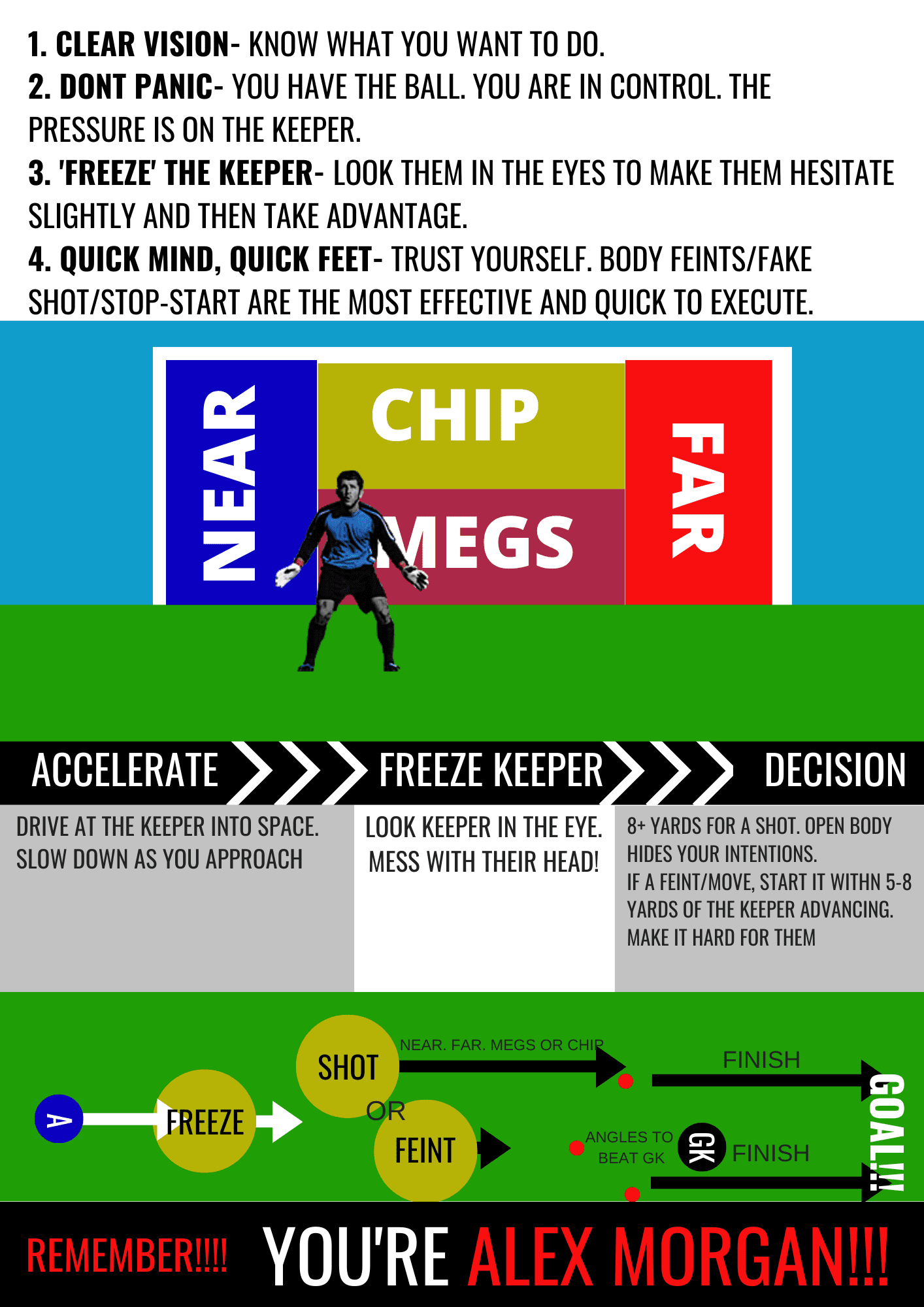
Figure: Beast Mode Soccer’s “1v1 to Keeper” mental cheat sheet, used with Alex Morgan, illustrating the thought process behind finishing a breakaway. It emphasizes a three step mental routine: Accelerate at the defender/keeper, Freeze them with a feint or eye contact, then make your Decision. The visual shows four finish options, Near post, Far post, a Chip, or a “Meg” (between the keeper’s legs), the striker quickly chooses based on the keeper’s position. This kind of tool trains strikers to internalize decision triggers (like a keeper leaning or rushing out) and respond with the optimal finish under pressure.
Fast decision making isn’t just an innate gift; it can be trained. We use drills at Beast Mode Soccer to sharpen this “goal IQ.” For example, we’ll run a drill where the player receives a pass in the box with colored cones at the corners of the goal. A coach yells a color at the moment of first touch, say “red” for near post, “blue” for far post, and the striker must instantly finish to that target. The colors simulate cues (like seeing the keeper lean), forcing quick pattern recognition and action. Another drill might flash a number on a screen as the ball is played, odd means one touch finish, even means take a prep touch. These cognitive triggers push the brain to process info instantly while executing technique. Over time, the striker’s mind speeds up. They start seeing the tells: a defender shifting weight means cut the other way, the goalie crouching early means maybe go high. By game day, it feels like the game “slows down” for them, because their processing is so advanced. As one sports scientist put it, soccer is a dynamic game of continuous decision making, and the best forwards have turned rapid, correct decision making into an art form.
Reaction to Failure
Every striker, no matter how great, misses chances. The separating factor is what happens next. The mental response to failure, a flubbed shot, a saved penalty, a bad game, defines a true goal scorer. The worst thing a striker can do after a miss is dwell on it. Hesitation and doubt start to creep in, and suddenly a second miss follows, then a third… a downward spiral. Elite strikers have a sort of selective amnesia. Miss? What miss? They move on immediately, as if it never happened. It’s not that they don’t care, it’s that they refuse to let one failure snowball into the next play.
I teach a simple Beast Mode Soccer rule: “Every next touch is your first one.” Treat the next shot as a clean slate, with zero baggage from the last. This mindset is crucial. A study on youth players showed that resilient players actually increase their effort after setbacks and maintain composure, whereas fragile minded players’ games unravel after a mistake . In practical terms, I’ve seen it time and again: a resilient striker misses a sitter and immediately claps their hands, yells “next one!” and keeps hunting for a goal . A less confident player hangs their head and goes into a shell, hiding from the ball. The top forwards want the ball even more after a miss. They have the guts to show for a penalty minutes after blowing an easy chance. They know that the only way to erase a miss is to bury the next opportunity.
Alex Morgan is a great example. She might sky a shot into Row Z, but you’ll see no change in her body language, she’ll keep making the same runs and taking the next shot that comes. Often, I’ve seen her miss an average chance and then score an absolute screamer a few minutes later. It’s like the miss flips a switch in her: focus more and make it count. Her late game heroics highlight this resilience. Morgan’s famous 123rd minute winning goal in the 2012 Olympic semifinal came after many earlier misses in that match. Lesser players might have faded; Alex just kept knocking on the door until it opened. This ability to not hesitate after failure is vital. Hesitation is a killer for strikers, that extra half second of doubt (“Should I shoot left or right? What if I miss again?”) gives defenders and goalkeepers the edge. The elite train themselves to react, not overthink, especially following a mistake.
From a sports psychology view, this is about mindset and self talk. Top scorers have positive, short memory self talk. They literally tell themselves things like “shake it off” or “next one” out loud. They might even smile after missing, as crazy as that sounds, to trick the brain into staying relaxed. The data shows resilient athletes don’t avoid the ball after errors; they engage more . They channel any frustration into working harder and staying sharp for the next chance. As a coach, I sometimes intentionally put players in scenarios to train this: for instance, a drill where they must do a difficult finishing rep, likely miss, and immediately I feed another ball for a simple finish. The instruction is they must score the second. This conditions the mind to let go of the miss and quickly refocus. You build the habit of instant rebound.
One technique we use is the “flush” moment, after a miss in training, the player does a quick physical gesture (clap, snap fingers, or literally pretend to flush a toilet) as a goofy mental cue to flush the miss away. It sounds silly, but it works. It breaks the emotional hold of the mistake. The next ball coming in is a new opportunity, not a lingering ghost of the last. The greatest strikers have this ruthlessness: they could miss three sitters and still demand the ball for a fourth chance in the 90th minute. That’s how winners think. As one of my mentors used to say, strikers must have goldfish memories. Ten seconds after a miss, it’s forgotten, the only thing that matters is the next shot.
Routine, Repetition & Preparation
Behind every “overnight success” on the scoresheet, there are countless hours of preparation that nobody sees. The mental aspects of finishing aren’t turned on at kickoff, they’re honed day in and day out through routine and repetition. World class strikers treat their mental training with the same seriousness as their shooting technique or fitness. They build habits and routines that fortify their mindset under pressure.
One common habit is visualization. Many elite finishers have a daily or pre game visualization ritual. It might be 5 minutes long, but it’s powerful. They’ll close their eyes and see themselves scoring, the ball hitting the net, the feeling of celebration, even the sound of the crowd. They imagine different scenarios: a breakaway against the keeper, a volley from a cross, a penalty in a shootout. This mental rehearsal primes the brain and body. Neuroscience shows that when athletes vividly imagine performing an action, the brain activates similar pathways as actually doing it, improving motor skills and decision making . In essence, you’re scoring goals in your mind before you ever do it on the field. When game time comes, it feels almost familiar. This builds huge confidence. As noted earlier, visualization also reduces anxiety, you’ve conquered the moment in your head, so why fear it in reality? Every top striker I know uses this in some form. Before big games, I’ve seen players like Mallory Swanson off in a corner, eyes closed, taking imaginary shots, prepping the mental muscle memory.
Another critical piece of preparation is journaling and film study. The best finishers are students of the game. They journal their training: noting how many shots they hit, which felt best, any negative thoughts that crept in, and how they overcame them. This reflective practice helps identify patterns. Maybe they notice “When I rush my shot after a miss, I tend to miss hit, next time, take a breath.” Writing these down cements lessons and also serves as a confidence log. Before a match, reading entries like “Scored 8/10 on left foot volleys in training, feeling sharp” boosts belief. Film breakdown is another tool for building tactical intelligence and confidence. Strikers will watch not just their highlights (to reinforce what works), but also their misses, and crucially, great strikers around the world. For instance, a young forward might study how Robert Lewandowski or Sam Kerr moves in the box, or how Alex Morgan times her runs. By analyzing film, they pick up little triggers: the way a defender’s hips turn that signals where to shoot, or the goalkeeper’s positioning that leaves a gap. They essentially expand their mental library of situations, which feeds back into that goal IQ. When I work with players, we often do film homework: identify three times you hesitated and what the better decision was. Over time, this kind of prep makes their in game choices more automatic and informed.
Crucially, practice must simulate pressure if you want mental growth. It’s not enough to shoot 100 balls in easy conditions. Elite strikers train with added stressors: fatigue, competition, consequences. As the saying goes, train hard, win easy. I often have Rachel Daly do finishing drills at the end of a grueling workout, legs heavy, heart pounding, because in the 85th minute of a match, that’s how it’ll feel. She shoots when exhausted so that scoring tired in a game is second nature. I’ll have her take five shots in a row, then immediately pretend she missed an open goal and needs to score one more “chance” to make up for it. She might imagine there are five defenders closing her down in that moment. “Rachel Daly doesn’t just shoot. She shoots with fatigue. She shoots after failure. She shoots with 5 defenders in her head.” The result? Come game day, a single defender and a goalkeeper aren’t half as intimidating, she’s scored in far worse situations in her mind.
We also add cognitive loads to drills. A favorite is the dual task finishing exercise: While sprinting to get on the end of a cross, the player also has to listen for a call or solve a quick number puzzle shouted by the coach, then finish. It forces them to keep their brain working under physical pressure, just like a real game, where you’re fighting exhaustion and still must make good decisions. These methods train what I call pressure proof decision making. The more you rehearse clutch moments in training, the more routine they feel in matches. A player like Alex Morgan might do a drill where every shot is “90th minute to win it”. Over time, taking that actual 90th minute shot feels no different than on the practice ground.
Finally, preparation builds ruthless consistency. World class strikers are ruthless with themselves in practice. They don’t end a session on a miss. If their target was 8 out of 10 conversions and they only hit 7, they’ll stay until they get that 8th. This isn’t just physical repetition, it’s mental. It teaches the brain that good enough is never good enough. That instills a habit of focus and high standards. When these players step up to a real chance, that same focus kicks in: you finish the job, because that’s what you’ve trained to expect of yourself.
The Mental Scorer’s Profile
Combining all these aspects, we can sketch the mental profile of an elite scorer. I’d boil it down to six essential traits:
Selective Amnesia, The ability to immediately forget mistakes or misses. A world class striker has a short memory for failure. Missed two sitters? It doesn’t matter, the next chance is all that counts. This trait keeps them free of baggage and fear. They remember lessons, not failures.
Ice Cold Confidence, An unshakeable belief in their ability to score, regardless of pressure or circumstance. This isn’t cockiness for show; it’s a deep inner calm. In crunch time, a penalty shootout or a one on one in stoppage time, they are the eye of the storm. Their self belief has been built over years and they trust it completely.
Tactical Shot Selection, The brains to choose the right finish for the right moment. Elite strikers rarely “hit and hope.” They assess: the keeper’s off his line? Go for the chip. Defender closing fast? Use one touch and shoot low far post. They have a menu of finishing options (inside foot placement, laces power, chip, curve, etc.) and select deliberately based on the situation. This tactical intelligence means their goals look clinical, not random.
Ruthless Repetition, A commitment to relentless practice of finishing skills and scenarios. They’ve taken tens of thousands of shots in training, with both feet, from all angles, under all conditions. This ingrains not just technique but mental endurance. They don’t get bored of the basics. The mentality here is do it again, and again, until it’s perfect. That repetition underpins their confidence, they know they’ve put in the work, so they expect results.
Anticipation & Instinct, A sixth sense for where the ball will be and how a play will unfold. Top scorers seem to react faster, but it’s often because they anticipated it. They read the game exceptionally well (a lot of this comes from film study and experience). Their instincts, when to make a run, when to hang back for a cut back, when to one time versus control, are finely tuned. It’s almost unconscious competence, decisions made in the gut that are usually spot on.
Pressure Proof Decision Making, The capacity to make good decisions under intense pressure. Whether it’s the last minute of a cup final or coming on as a sub with one chance to prove yourself, these players make the same quality of decision as they would on the training ground. Their mental circuitry has been stress tested in practice, so it doesn’t short circuit in games. They follow their routine, trust their read, and execute, no matter the chaos around them.
Now, developing this profile is a journey. It won’t happen just by reading about it, you have to train it. Here’s a quick training toolkit to start sharpening the mental side of your finishing:
Five Minute Visualization Script: Every day, take five minutes in a quiet space. Close your eyes and run a “mental highlight reel.” Imagine receiving a perfect pass and calmly slotting it in the corner. Feel the emotion of scoring. See yourself facing a keeper one on one: you give a shoulder fake, the keeper bites, you slide the ball under them into the net. Picture a penalty, hear the crowd, see yourself breathe, and bury it. Vividly rehearse 3 4 goal scenarios. This primes your mind to be confident and prepared for them in real matches .
Three Trigger Phrases: Develop short phrases to center yourself during games. Examples: “Next one.” (after a miss, reminds you to forget it and be ready for the next opportunity), “Composed.” (before an important shot, reminds you to stay calm and stick to your technique), or “Attack!” (to fire yourself up to aggressively seek chances). These triggers should be personal and meaningful to you. Use them in training whenever you face a setback or a pressure moment, so they become automatic in games. They act as mental cues to get you back into the optimal mindset.
Film Study & Journaling Tips: Each week, pick one aspect of your game to analyze on film. Maybe your runs in the box: Are you moving intelligently? Did you attack the right areas? Or look at your shot selection: Did you opt for power when placement would do (or vice versa)? Note down observations and one improvement to focus on next session. Also, keep a journal of your training. Log your shot totals and success rates on different drills. Write about how you felt, e.g., “Felt anxious on first few shots, improved after slowing my breathing.” Over time you’ll spot patterns and progress. Before games, review your notes about successful sessions to boost your confidence (you have proof you’ve scored these in practice).
BMS Style Confidence Reset Drill: Incorporate a drill that trains you to reset after misses. One I use: set up 5 balls around the top of the box. Take a shot with the first ball, simulate a bad miss (send it over the bar on purpose). Immediately move to the next ball and demand of yourself to score it cleanly. Then the next, and so on. The goal is to go 4 for 5 after that first “miss.” This drill mimics a game where you shank one chance but must stay locked in for the next. It builds the habit of not letting one miss affect the following attempt. Another twist: do a quick 5 burpees or a short sprint before a one on one finishing attempt, so you’re winded (simulating pressure), then finish. If you miss, do a quick “flush” (clap or shout “forget it!”) and immediately take another ball to goal. These routines physically and mentally reinforce moving on and executing under pressure.
Finally, remember that every great striker’s journey is a marathon of constant mental tuning. You sharpen these skills week by week, game by game. The beautiful thing about the mental side is that it’s 100% in your control. You can’t always grow six inches taller or suddenly become lightning fast, but you can absolutely train yourself to be mentally stronger, sharper, and more resilient. The tools above, visualization, self talk triggers, simulation drills, etc., are how you do it.
In closing, technique and talent may get you into the elite ranks, but mindset is what keeps you there and separates you from the pack. Scoring goals at the highest level requires a mental edge, the audacity to believe you’ll score, the fortitude to bounce back when you don’t, the intelligence to outwit defenders in a heartbeat, and the calm to execute under fire. Train your mind as hard as you train your finishing. Or stop calling yourself a striker.